

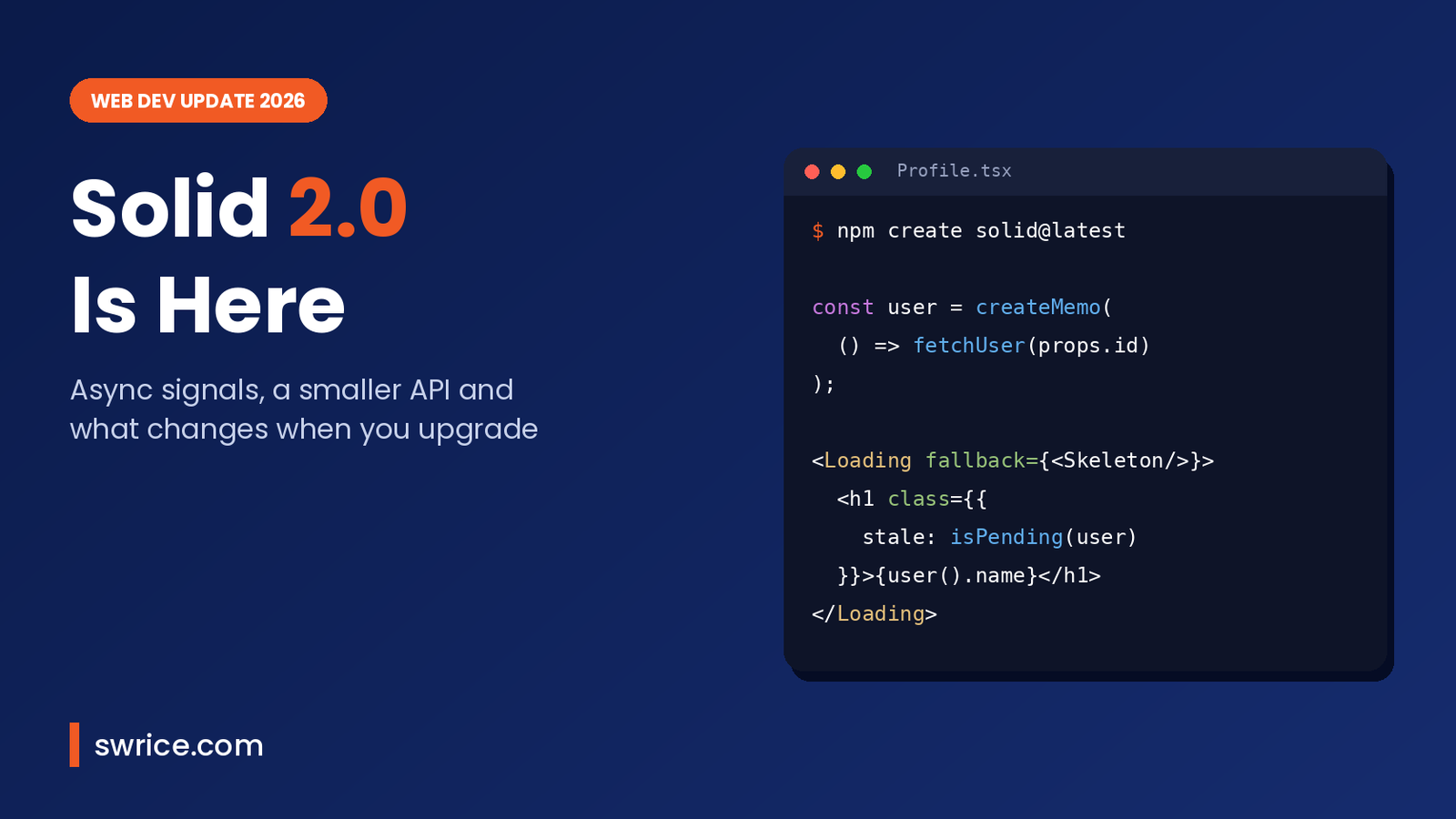
Solid 2.0 is now stable. Ryan Carniato announced the release on the official Solid blog on November 16, 2026, five years after Solid 1.0. This is a big release. It moves async work into the reactive graph, brings server functions into core and removes a long list of older APIs.
In this guide, we explain what changed, what breaks and how to upgrade an existing app. We also cover the new diagnostics that target AI coding agents. Code examples are short, so you can try each idea quickly.
What Is Solid 2.0?
SolidJS is a UI library built on fine-grained reactivity. In other words, it uses signals and updates the DOM directly, without a virtual DOM. Solid 1.0 made that bet in 2021. Today, signals also power Angular, Svelte runes and Vue Vapor Mode.
Solid 2.0 is the next major version of that library. The team rewrote the reactive core from scratch. According to the GitHub release notes, they shipped 23 release candidates in 14 weeks, merged 971 pull requests and closed 753 issues before calling it stable.
The timeline was long. The road to 2.0 was announced in February 2025. Then the beta landed in March 2026, and the release candidate followed in August with a frozen API.
Key Features in Solid 2.0
The release focuses on four big ideas. Each one changes how you write everyday Solid code, so it is worth knowing them before you upgrade.
1. Async Is Part of the Reactive Graph
This is the headline change. A computation can now return a Promise or an async iterator.
Everything downstream understands that value, so you no longer need a separate early resource definition. As a result, race conditions and loading states are handled for you.
Here is the pattern from the announcement, slightly trimmed:
function Profile(props) {
  const user = createMemo(() => fetchUser(props.id));

  return (
    <Loading fallback={<Skeleton />}>
      <h1 class={{ stale: isPending(user) }}>{user().name}</h1>
    </Loading>
  );
}
Notice two new names. First, <Loading> replaces <Suspense>, and it only handles the first render. After that, the UI stays on screen while new data loads. Second, isPending() tells you when background work is in flight. For example, you can dim stale content instead of showing a spinner.
2. Server Functions Move Into Core
SolidStart introduced server functions in 2022. Now they live in Solid itself. They support classic request/response calls and also persistent streams over Server-Sent Events. Consuming a live stream looks like this:
import { live } from "@solidjs/web/server-functions";

const stockPrice = live(async function* (symbol: string) {
  "use server";
  for await (const tick of subscribe(symbol)) yield tick.price;
});

// in your component
const price = createMemo(() => stockPrice());
The team also says reactive Server Components are coming soon. However, they are still experimental, so do not plan production work around them yet.
3. Diagnostics Built for AI Coding Agents
Most frameworks fail silently when reactive code is wrong. Solid 2.0 takes a different approach. Development builds report mistakes with a stable code, the source location and a suggested fix.
For instance, reading a signal in the wrong place produces a STRICT_READ_UNTRACKED warning. The message links to the docs and to an agent repair guide shipped inside the solid-js package. Because the graph knows what was read and where, it can also flag waterfalls, runaway effects and graphs that will not scale.
This matters if you use tools like Claude Code or Cursor. The agent gets precise feedback instead of guessing. If you work this way already, our guide to Chrome DevTools MCP shows another way to give agents better runtime context.
4. A Smaller API
Surprisingly, a bigger feature set came with a smaller API. The announcement lists these removed primitives:
createResource(use asynccreateMemoinstead)batchandstartTransitiononandcreateComputedproduceandcreateMutable
The idea is to derive state rather than sync it by hand. Consequently, there are fewer escape hatches that can cause bugs.
SolidStart Is Retired: What Replaces It?
This is the change most teams will notice first. The Solid team has retired SolidStart, its official meta-framework. Instead, the pieces a meta-framework needs now live in core or in framework-agnostic Vite plugins.
According to the release candidate announcement, “start mode” replaces SolidStart. Server functions, the serving layer and file-system routing each moved to a new home. Solid Router 2.0 shipped alongside the RC, and a TanStack template pairs TanStack Router and TanStack Query with start mode.
In practice, this means you pick your own router and data layer. That gives you more freedom. On the other hand, it also means more decisions for new projects.
Breaking Changes in Solid 2.0
Solid 2.0 is not a drop-in upgrade. Based on the beta release notes and the migration guide, these are the changes you are most likely to hit:
- Removed primitives: the APIs listed above are gone.
- Suspense becomes Loading:
<Loading>covers initial readiness only. - List rendering:
<Index>is replaced by<For keyed={false}>, andForchildren now receive accessors. - Effects:
createEffectis split into a compute step and an apply step. - Directives:
use:directives are replaced byrefdirective factories. - Classes:
classListis folded intoclass. - Packages: the web runtime now lives in
@solidjs/web, so imports fromsolid-js/webmust change.
Library authors should also check their peer dependencies. Many community packages released new majors that require Solid 2.0.
How to Upgrade to Solid 2.0
Upgrading a real app takes planning. Follow these steps to keep the risk low.
Step 1: Start a Test Project
First, create a fresh project so you can learn the new patterns in isolation:
npm create solid@latestStep 2: Read the Migration Guide
Next, read the migration guide and the topic docs on docs.solidjs.com. They cover reactivity, control flow, stores, async data and actions in detail.
Step 3: Upgrade Dependencies on a Branch
Then, update solid-js, add @solidjs/web and update your Vite plugin on a separate branch. Check every Solid library you use for a 2.0-compatible release before you merge.
Step 4: Replace Removed APIs
After that, convert each createResource to an async createMemo. Swap <Suspense> for <Loading> and add isPending where you want stale states. Finally, run the dev build and fix every diagnostic it reports.
Not ready yet? Solid 1.x stays available on npm as solid-js@v1-latest, with docs at v1.solidjs.com. So you can pin it while your ecosystem catches up.
Should You Switch to Solid 2.0 Now?
For new projects, Solid 2.0 is a strong choice if you like signals and want built-in async handling. The diagnostics are also a real plus for teams using AI agents.
For existing apps, the answer depends on your stack. If you rely heavily on SolidStart or on libraries that have not updated, wait a few weeks. Meanwhile, compare ideas across frameworks. For example, our posts on Vue Vapor Mode and SvelteKit 3 show how other teams handle the same problems.
Solid 2.0 FAQ
When was Solid 2.0 released?
The stable release was announced on November 16, 2026, on the official Solid blog.
Is Solid 2.0 backward compatible with Solid 1.x?
No. Several APIs were removed and some components were renamed, so most apps need code changes.
What happened to SolidStart?
It was retired. Start mode, core server functions and Vite plugins now cover its features.
Can I keep using Solid 1.x?
Yes. Install solid-js@v1-latest and use the v1 docs until you are ready to migrate.
Conclusion
Solid 2.0 is a confident, opinionated release. It puts async into the reactive graph, moves server functions into core and trims the API. In addition, its diagnostics give both humans and AI agents clear, actionable errors. Start with a test project, read the migration guide and upgrade one feature at a time.
Sources
Need Help With Your Website or Web App?
Swrice builds and customises WordPress sites, plugins and web apps. Whether you need an upgrade, a custom feature or a fix, our team can handle it for you.
Leave a Reply