

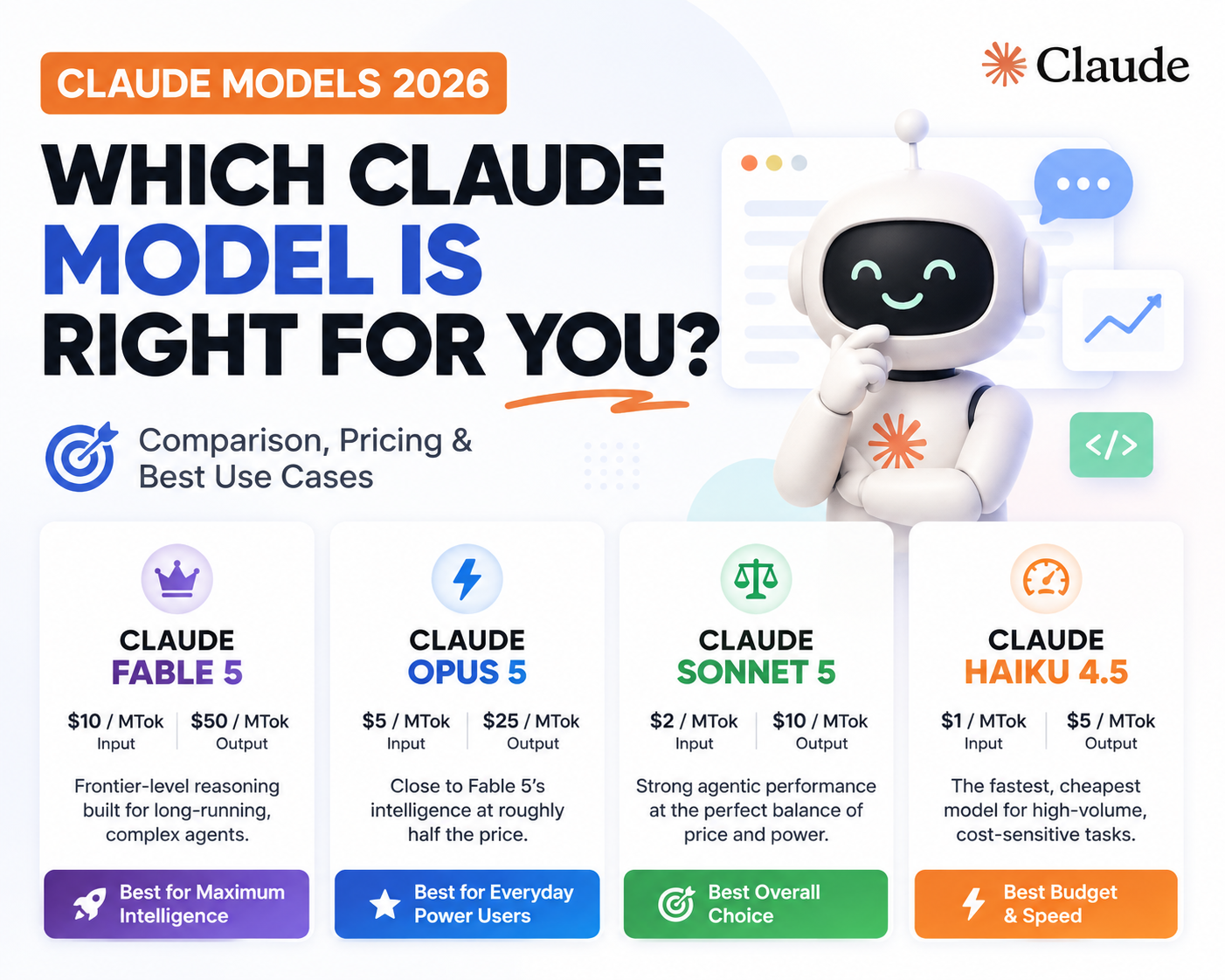
Choosing the right Claude model can feel confusing now that Anthropic offers four models in its lineup, Claude Fable 5, Claude Opus 5, Claude Sonnet 5, and Claude Haiku 4.5, each built for a different balance of speed, intelligence, and price. Whether you are building an autonomous coding agent, a customer support chatbot, or simply chatting through Claude.ai, picking the wrong model can mean overpaying for intelligence you do not need, or underpowering a task that needed more reasoning. In this Claude models comparison, we break down the full 2026 lineup so you can match the right model to your workload with confidence.
Every model in the current Claude family shares the same core skills: vision, tool use, multilingual support, and a large context window, but they differ sharply in pricing, latency, and how much reasoning they apply before answering. Below you will find a quick recommendation, a full side-by-side comparison table, a breakdown of each model, and a decision guide to help you choose based on your budget and use case.
Quick Answer: Best Claude Model 2026
If you want a fast recommendation, Claude Sonnet 5 is the best all-round choice for most developers and teams, thanks to its strong agentic performance at just $2 per million input tokens and $10 per million output tokens. If your work involves the hardest reasoning problems, large-scale refactors, or research that cannot afford mistakes, Claude Opus 5 is the strongest general-purpose option, while Claude Fable 5 pushes further still for the most demanding, long-running autonomous agents. Teams running high-volume, latency-sensitive workloads such as chat routing, classification, or simple support queries get the best value from Claude Haiku 4.5.
Claude Models 2026 at a Glance
- Best Overall: Claude Sonnet 5, Anthropic’s most agentic Sonnet yet, balancing near-Opus performance with a fraction of the cost
- Best for Maximum Intelligence: Claude Fable 5, frontier-level reasoning built for long-running, complex agents
- Best for Everyday Power Users: Claude Opus 5, comes close to Fable 5’s intelligence at roughly half the price
- Best Budget and Speed: Claude Haiku 4.5, the fastest, cheapest model with near-frontier intelligence
- Best for Specialized Security Work: Claude Mythos 5, an invitation-only model built for defensive cybersecurity workflows
Claude Models Comparison Table 2026
Here is how the current Claude models compare side by side on context window, pricing, and knowledge cutoff:
| Model | Context Window | Input Price | Output Price | Knowledge Cutoff | Best For |
|---|---|---|---|---|---|
| Claude Fable 5 | 1M tokens | $10 / MTok | $50 / MTok | Jan 2026 | Long-running, high-stakes agents |
| Claude Opus 5 | 1M tokens | $5 / MTok | $25 / MTok | May 2026 | Complex coding & enterprise work |
| Claude Sonnet 5 | 1M tokens | $2 / MTok | $10 / MTok | Jan 2026 | Balanced everyday development |
| Claude Haiku 4.5 | 200K tokens | $1 / MTok | $5 / MTok | Feb 2025 | Fast, high-volume, cost-sensitive tasks |
Pricing reflects Anthropic’s published per-million-token rates as of August 2026 and can change. Always confirm current rates on Anthropic’s official pricing page before budgeting a production workload.
Claude Fable 5 Overview
Claude Fable 5 sits at the top of Anthropic’s lineup as the flagship model built for the next generation of long-running, highly autonomous agents. It is designed for the share of tasks where raw intelligence matters more than speed or cost: deep research, multi-day coding agents, and workflows that need to reason through many steps without losing the thread.
Key Features
- Frontier-level reasoning across coding, research, and multi-step planning
- 1 million token context window with a 128,000 token maximum output
- Adaptive thinking that is always active for deeper, self-checked answers
- Vision support for charts, screenshots, and documents
- January 2026 knowledge cutoff
Pricing
Claude Fable 5 costs $10 per million input tokens and $50 per million output tokens, the highest in the lineup, reflecting the added compute behind its always-on adaptive thinking.
Pros and Cons
- Strongest reasoning and planning of any Claude model
- Built specifically for long-running autonomous agent workflows
- Ten times the output cost of Haiku 4.5
- Overkill, and expensive, for simple day-to-day tasks
Claude Opus 5 Overview
Claude Opus 5 is Anthropic’s flagship everyday model, described by the company as coming close to Fable 5’s frontier intelligence at roughly half the price. It is the default model on Claude Max and the strongest option available on Claude Pro, making it the natural pick for developers who want top-tier reasoning without the Fable 5 price tag.
Key Features
- Handles complex agentic coding, large refactors, and enterprise workloads
- 1 million token context window with a 128,000 token maximum output
- Mid-conversation tool switching and automatic safety fallbacks
- Optional fast mode for roughly 2.5x faster generation
- May 2026 knowledge cutoff, the most recent of any current Claude model
Pricing
Claude Opus 5 costs $5 per million input tokens and $25 per million output tokens, the same rate carried over from Opus 4.8.
Pros and Cons
- Near-Fable 5 intelligence at half the cost
- Most current knowledge cutoff in the lineup
- Still five times pricier per output token than Sonnet 5
- Fast mode adds extra cost for latency-sensitive use cases
Claude Sonnet 5 Overview
Claude Sonnet 5 is Anthropic’s most agentic Sonnet model to date and the default model for Free and Pro plan users. Early testers note it finishes complex tasks that previous Sonnet versions would stop short on, and checks its own work without being asked, closing much of the old gap between Sonnet and Opus.
Key Features
- Strong agentic search, computer use, and coding performance
- 1 million token context window with a 128,000 token maximum output
- Performance that rivals Opus 4.8 on select high-effort tasks
- Updated tokenizer for improved handling of code and structured text
- January 2026 knowledge cutoff
Pricing
Claude Sonnet 5 costs $2 per million input tokens and $10 per million output tokens, keeping it firmly the best value-per-intelligence model Anthropic offers.
Pros and Cons
- Best balance of intelligence, speed, and price for most production use
- Default model for Claude’s Free and Pro plans
- Slightly behind Opus 5 and Fable 5 on the hardest reasoning benchmarks
- Updated tokenizer can use more tokens for some content types than older Sonnet versions
Claude Haiku 4.5 Overview
Claude Haiku 4.5 is built for speed. Anthropic positions it as the fastest model in the lineup with near-frontier intelligence, making it the go-to choice for high-volume, latency-sensitive applications like chat routing, classification, and simple customer support.
Key Features
- Fastest response times of any current Claude model
- 200,000 token context window with a 64,000 token maximum output
- Vision support alongside extended thinking for deeper reasoning when needed
- Lowest price in the lineup at $1 per million input tokens
- February 2025 knowledge cutoff
Pricing
Claude Haiku 4.5 costs $1 per million input tokens and $5 per million output tokens, roughly a fifth of Sonnet 5’s output price.
Pros and Cons
- Cheapest and fastest model Anthropic offers
- Only current Claude model with an explicit extended thinking mode
- Smaller 200,000 token context window than the rest of the lineup
- Older knowledge cutoff than Fable 5, Opus 5, and Sonnet 5
Key Differences Between Claude Models
When comparing Claude models, these are the factors that matter most:
- Context Window: Fable 5, Opus 5, and Sonnet 5 all share a 1 million token window, while Haiku 4.5 is capped at 200,000 tokens.
- Pricing Philosophy: Cost scales directly with capability. Haiku 4.5 is the cheapest per token and Fable 5 is the most expensive, with Opus 5 and Sonnet 5 in between.
- Extended Thinking: Haiku 4.5 is the only current model with an explicit extended thinking mode, while Fable 5, Opus 5, and Sonnet 5 rely on adaptive thinking that scales automatically with task difficulty.
- Speed vs Intelligence: Haiku 4.5 trades reasoning depth for the fastest responses, while Fable 5 sits at the opposite end, prioritizing depth over latency.
- Knowledge Cutoff: Opus 5 currently has the most recent training data at May 2026, ahead of Sonnet 5 and Fable 5 at January 2026 and Haiku 4.5 at February 2025.
- Availability: Sonnet 5 is the default for Free and Pro plans, Opus 5 is the default for Max, and Fable 5 and the specialized Mythos 5 model are reserved for the most demanding or restricted workflows.
How to Choose the Right Claude Model for Your Use Case
The right Claude model depends on what you are building and what you can afford to pay per request. If you are building a general-purpose coding assistant, customer-facing chatbot, or content workflow, start with Claude Sonnet 5, it delivers the best balance of intelligence and cost for the vast majority of production applications. If your workload involves the hardest reasoning problems, such as complex agentic coding, deep research, or multi-step planning where mistakes are costly, move up to Claude Opus 5 or Claude Fable 5 depending on your budget. For high-volume, latency-sensitive tasks like routing, tagging, or simple support replies, Claude Haiku 4.5 keeps costs down without sacrificing much quality. Many teams get the best results by combining models, using Haiku 4.5 to triage requests and escalating only the harder ones to Sonnet 5 or Opus 5. For the latest specifications and official pricing, check Anthropic’s models overview and pricing pages directly, since Anthropic updates its lineup and rates several times a year.
Frequently Asked Questions
What is the best Claude model in 2026?
For most people and teams, Claude Sonnet 5 is the best all-round Claude model in 2026 because it offers near-Opus performance at a fraction of the cost. Users who need the absolute highest reasoning quality should choose Claude Opus 5 or Claude Fable 5 instead.
What is the difference between Claude Opus 5 and Claude Sonnet 5?
Claude Opus 5 is built for the hardest reasoning and coding tasks and costs $5 per million input tokens and $25 per million output tokens, while Claude Sonnet 5 is optimized for everyday agentic work at $2 per million input tokens and $10 per million output tokens. Opus 5 also has a more recent knowledge cutoff of May 2026 compared to Sonnet 5’s January 2026.
Which Claude model is cheapest?
Claude Haiku 4.5 is the cheapest current Claude model at $1 per million input tokens and $5 per million output tokens. It is also the fastest model in the lineup, making it ideal for high-volume, cost-sensitive applications.
What is Claude Fable 5 used for?
Claude Fable 5 is Anthropic’s flagship model for long-running, highly autonomous agents that need frontier-level reasoning across many steps, such as extended coding agents, deep research tasks, and complex multi-stage workflows.
Do all Claude models support vision and tool use?
Yes. Every current Claude model, Fable 5, Opus 5, Sonnet 5, and Haiku 4.5, supports image input, tool use, multilingual conversations, and prompt caching. The main differences come down to context window size, pricing, and how much reasoning each model applies before responding.
Final Thoughts
There is no single best Claude model for everyone, only the best Claude model for your specific task and budget. Claude Sonnet 5 remains the smart default for most development work, while Claude Opus 5 and Claude Fable 5 are there for the reasoning-heavy jobs that justify the extra cost, and Claude Haiku 4.5 keeps high-volume workloads fast and affordable. Start with Sonnet 5, measure where it falls short, and move up or down the lineup based on real results rather than specs alone.
Leave a Reply