

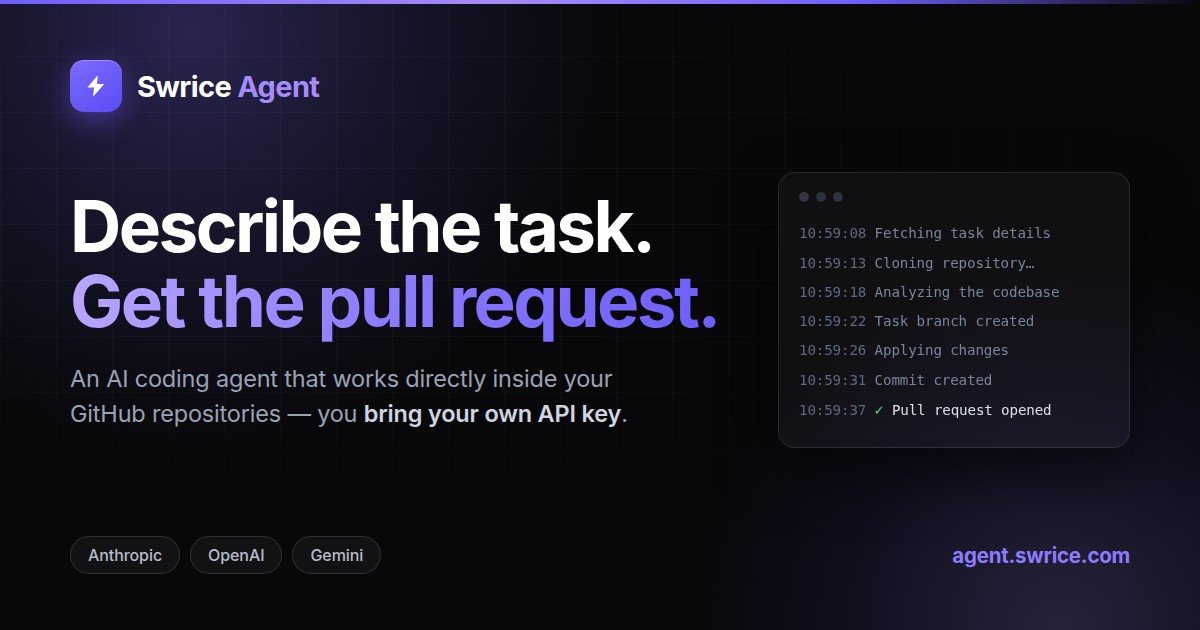
Every codebase has a backlog of small work nobody wants to pick up. A deprecated function to swap. A null check to add. A constant to update across three files. None of it is difficult, but all of it costs a context switch and twenty minutes you had planned to spend elsewhere. An AI coding agent for GitHub is built for exactly that layer of work.
You describe the change in plain English, the agent works inside your actual repository, and it opens a pull request you review like any other. This guide covers what these agents genuinely do well in 2026, where they still need a human, and what running one costs.
Quick Answer
For small, clearly described changes, an agent will usually finish faster than it takes you to set up a local branch. It is strongest when you can name the file, the function or the symbol you want changed.
It is not a replacement for a developer on architecture, cross-system debugging, or anything security sensitive. Every change still needs a human review before merge. The useful mental model is a fast, tireless junior who never minds small tickets.
What Is an AI Coding Agent for GitHub?
An AI coding agent connects to your repository, clones it into a temporary environment, edits files, and opens a pull request. It reads your real code rather than guessing from a conversation.
That is the difference from pasting snippets into a chatbot. A chatbot writes code that might fit your project. An agent works inside the project, so it can find the function, see how it is called, and change it where it lives.
Three things separate a useful agent from a demo:
- It opens real pull requests. Not a patch in a chat window you then have to apply yourself.
- It shows its work. Clone, search, edit, validate, each step visible and timestamped.
- It never merges on its own. Your branch protection and review process stay exactly as they were.
Which Tasks Suit an AI Coding Agent for GitHub
The shape of the task matters far more than the language it is written in.
| Task type | Suits an agent? | Why |
|---|---|---|
| Remove or rename a known function | Yes | Exact symbol, easy to verify in the diff |
| Add a null check or guard clause | Yes | Small, local and well defined |
| Update a constant, version or endpoint | Yes | Mechanical, appears in known places |
| Add a field following an existing pattern | Usually | The file already shows it what to copy |
| Migrate a deprecated API call | Usually | Repetitive across several files |
| Fix a failing test | Sometimes | Depends how much of the stack is involved |
| Redesign a data model | No | Needs judgement, planning and migrations |
| Anything touching auth or payments | No | Review cost outweighs the time saved |
The pattern is consistent. The more precisely you can name what should change, the better the result.
Language Support: The Question Worth Asking First
This is where tools in this category differ most, and where the marketing is least clear.
Several well known agents get their speed from a pre-computed code graph built with static analysis. That is genuinely fast, but the graph only covers the languages it was built for, commonly Python, TypeScript and JavaScript. If your work is in PHP, Ruby, Go, C# or Java, that advantage may not apply to you at all.
An agent that reads and writes files directly, and searches the codebase the way you would, has no such ceiling. It works in whatever your repository is written in, whether that is a Laravel backend, a Django service, a WordPress plugin, a Go CLI or a React frontend, because nothing in the approach is language specific. Swrice Agent takes this second approach, which is why it is not limited to a fixed set of languages.
Before committing to any tool, check that support for your stack is real rather than assumed.
How an AI Coding Agent for GitHub Works, Step by Step
1. Connect the repository
You install a GitHub App and choose exactly which repositories it can reach. Personal repositories or a whole organisation, that choice is yours, and you can revoke it from GitHub at any time.
2. Describe the change
Something like: remove the force_default_font function and the hook that registers it. Naming the symbol matters. Vague requests produce vague pull requests.
3. Review the pull request
The agent works on its own branch and finishes by opening a PR. You read the diff exactly as you would a colleague submission. A small change typically completes in under a minute, and your review is the part that takes real attention.
Bring Your Own Key: What It Actually Costs
Most AI tools resell you model tokens with a margin on top, and you never see what a given task cost. A better arrangement for developers is bring your own key. You add your own Anthropic, OpenAI or Google key, pay the provider directly at their prices, and the product charges a flat fee for itself. This is how Swrice Agent is priced, and it means every task shows you exactly how many tokens it spent.
There are two practical benefits. You see the real per-task cost instead of an opaque credit balance, and your provider limits apply rather than an artificial cap on how much reasoning the model is allowed to do.
For help choosing which model to point at this work, our Claude models comparison for 2026 covers current pricing and context windows, and the official model documentation lists the full lineup. A mid-tier model is usually the right default, because the strongest models earn their cost on genuinely hard problems rather than on deleting a function.
One counterintuitive point is worth knowing: a weaker model is often more expensive on agent work, not less. Weak models need more turns to reach the same result, and total cost grows faster than the turn count does.
What to Watch For With an AI Coding Agent
An honest account of the limits is more useful than a feature list.
- Automated validation is not universal. Depending on the tool and the language, a change can reach a pull request without a linter or test suite having run against it. Read the diff before you merge.
- Small requests beat big ones. Fix the checkout flow produces worse output than add a guard before order.total is read in checkout.js. Precision in, precision out.
- Watch the scope of the diff. If you asked for one function to be removed and eighty lines changed, something went wrong.
- Keep your review standards. Branch protection, required approvals and staging deploys should not relax because an agent opened the pull request.
Choosing an AI Coding Agent for GitHub
A few questions are worth asking before committing to any tool in this category:
- Does it open pull requests in your own repository, or hand you a patch to apply?
- Can you see every step it took, or only the final answer?
- Do you pay for model usage directly, or through the vendor markup?
- Can you scope repository access, and revoke it cleanly?
- Does it genuinely support your language, or only the ones its analysis engine covers?
Frequently Asked Questions
Which programming languages do these agents support?
It depends on the approach. Agents built on a pre-computed code graph typically support Python, TypeScript and JavaScript. Agents that read and write files directly work in any language your repository uses, including PHP, Go, Ruby, Java and C#.
Will it push directly to my main branch?
It should not. A well built agent works on its own branch and finishes with a pull request, so your branch protection rules continue to apply exactly as before.
Can it see my private code?
It clones your repository into a temporary environment for the duration of a single task. Look for a tool that discards that clone afterwards and lets you control which repositories it can reach.
How much does it cost to run?
With bring your own key pricing you pay your AI provider directly, plus a flat product fee. A small edit is typically a few cents of model usage. Larger tasks cost more because they require more reasoning, not because of a markup.
Is it worth it for a solo developer?
The value scales with repetition. If most of your work is deep and novel, the saving is modest. If you maintain several projects with recurring small tasks, the time back adds up quickly.
Do I still need a developer?
Yes. The agent handles the well scoped layer. Architecture, cross-system debugging, performance work and anything touching money or identity still need someone who understands the whole picture.
Final Thoughts
An AI coding agent for GitHub is neither magic nor a replacement for knowing your own codebase. What it does well is take the small, clearly described, endlessly recurring work off your desk and hand it back as a pull request a minute later.
Start with something low stakes in a repository you know well. Give it a task you would rather not do yourself, read the diff carefully, and judge it on that alone. If the change is clean and the reasoning is visible, you have found a real time saver.
If you want to try this on your own repository, Swrice Agent is free to start, needs no credit card, and opens its first pull request in about a minute. And if you would rather hand a project to people than to an agent, that is what our development services are for, and our plugin library covers the extensions we build and maintain ourselves. Questions about your particular stack? Get in touch.
Leave a Reply